NOT Including rodeos after Aug 11, 2026.
Table of contents
1. What is the Playoff Series?
It’s a season-long points race run across ProRodeo’s richest rodeos, with separate standings for barrel racing and breakaway roping, both posted by the WPRA. The brand has changed more than once: the ProRodeo Tour, then the NFR Playoff Series, now the Cinch Playoff Series. The 2026 schedule runs 59 rodeos, Denver in January through Pendleton in September, before the two playoff events themselves. WPRA describes the series as covering the PRCA’s 60 richest rodeos; the posted 2026 list comes to 59.
Two things it is not. Playoff Series points are not money, and they do not move a rider in the world standings. And the series does not end at one event. It feeds two, on two different deadlines.
2. How riders earn points
Points go to the top 20 placings at each Playoff Series rodeo, awarded on placing in the average, not on a single fast run. At a rodeo with one go-round or 10, it’s the average that pays.
The size of the pot depends on the rodeo. WPRA sets three levels of distribution based on a rodeo’s total payout, and every placing is a fixed percentage of that level’s base:
- $650,000 and above: 1,000-point base
- $325,000 to $649,999: 750-point base
- $324,999 and below: 500-point base
The percentages are identical at all three levels. Winning is worth 15% of the base wherever a rider does it. It’s simply worth more points at a bigger rodeo, which is the whole design: the series is built to reward showing up where the money is.
3. What a placing is worth
Playoff Series point distribution, from the schedule WPRA publishes on its Playoff Series page. Points are paid 20 placings deep; the top 15 are shown here. The total payout that sets a rodeo’s tier includes steer roping, breakaway and barrel racing.
The curve is steep at the top and flat at the bottom. A win at the richest tier pays 150, while 11th through 15th at that same rodeo pay 130 points between the five of them. Winning one big rodeo is worth more than placing quietly at four small ones: 150 for a victory at the top tier against 130 for four eighth-place finishes at the bottom one. That arithmetic is why the top of these standings can reorder in a single weekend.
4. What costs a rider points
A no-time or no-score earns nothing. There’s no participation credit, and a rider without a qualified run at that rodeo is simply not in the distribution. Turning out is worse than not entering: a turnout at a Playoff Series rodeo carries up to a 10-point deduction, notified or not, and monetary turnout fines are doubled at series rodeos. Vet releases and doctor releases are excluded from the deduction. Points also only count at rodeos a rider entered as an official entry.
5. How tournament rodeos are scored
Bracketed rodeos have no clean average, so points follow how far a rider advances. Riders who reach the final round take the top placings, ordered by their times in that round. The points for the places below them cascade backward through the semifinals, then the wild card, then the bracket averages, until all 20 placings are filled. Where a round produces fewer qualified times than there are riders in it, the points for the unfilled places are split evenly among the riders who did not record one.
6. The part most people get wrong: there are two cutoffs
It’s easy to read that scoring closes on Monday, Aug. 24 and assume the series is over. It isn’t. Aug. 24 sets the Puyallup field only. Per the WPRA schedule, that cutoff takes in points from Caldwell, Canby, Gooding and Moses Lake, and does not include Kennewick, Bremerton or Tremonton.
The automatic Governor’s Cup berths are not settled until Monday, Sept. 21, the Monday after Mandan and Pendleton finish. Riders keep earning series points for a full month after Puyallup’s field is locked, which means a rider can miss Puyallup in August and still be racing for Sioux Falls in September.
Entries for Puyallup open Friday, Aug. 21 and close Tuesday, Aug. 25.
7. Who goes to Puyallup
A field of 24: the top 23 in Playoff Series points at the Aug. 24 cutoff, plus the NFR Open champion. It runs Sept. 10–13, 2026, at the Washington State Fair in Puyallup, Wash., billed as the Cinch Playoffs Wild Card. The top four advance.
8. Who goes to the Governor’s Cup
A field of 12: the top four out of Puyallup, plus the top eight in Playoff Series points as of Sept. 21. Those are two separate doors, and the second one stays open a month longer than the first.
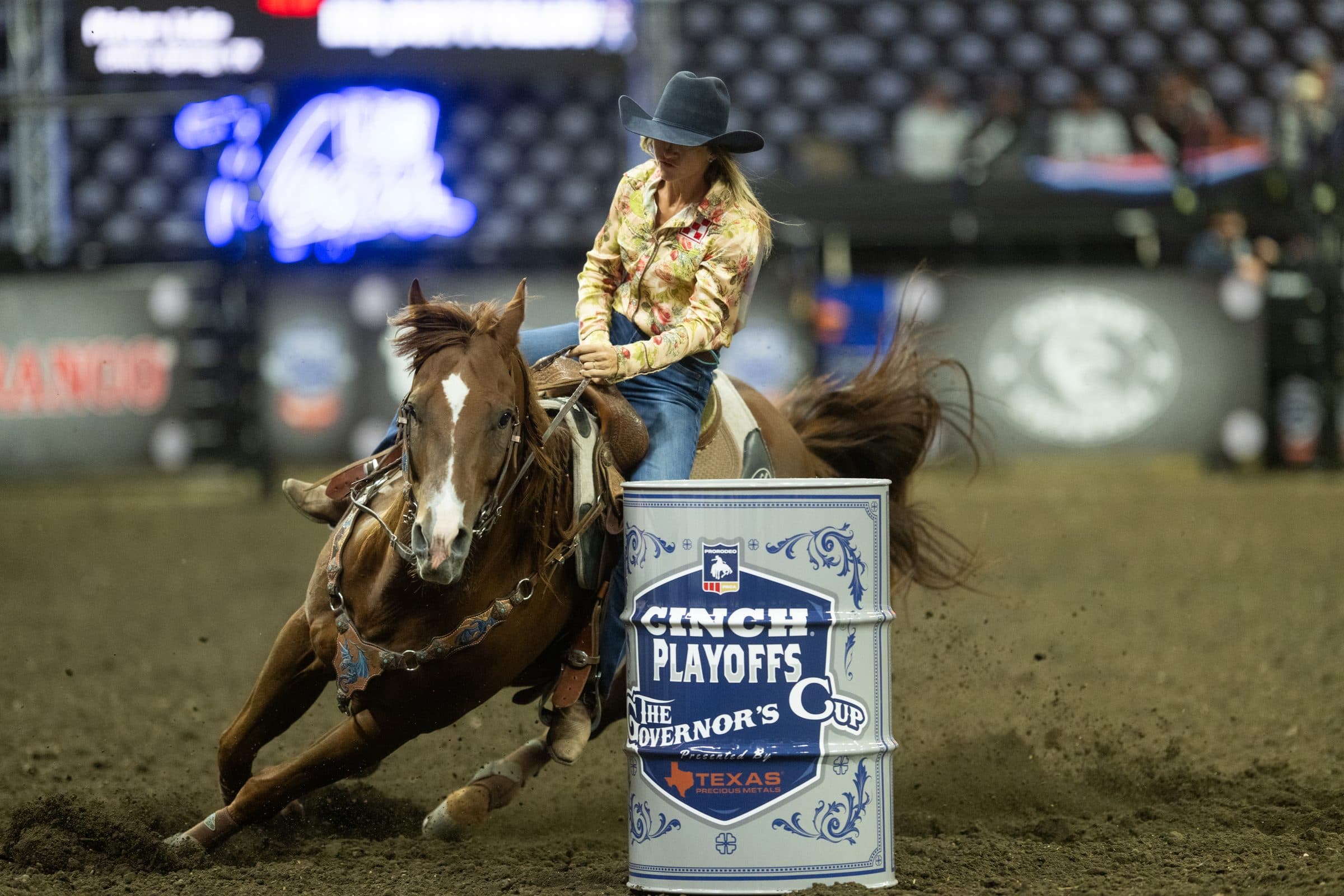
The Cinch Playoffs Governor’s Cup runs Sept. 25–27, 2026, at the Denny Sanford Premier Center in Sioux Falls, S.D., with more than $1.5 million on offer across eight events. The format moves in three stages: two full rounds for all 12, then a clean-slate semifinal for the top eight, then a winner-take-all short round for the final four.
9. Why it matters for the NFR
Money won at Puyallup and at the Governor’s Cup counts toward the WPRA world standings, and both land inside the regular season, late. A rider sitting outside the top 15 in mid-September can still ride into it on the final weekend, which is why two events in a 60-rodeo series carry weight out of all proportion to their number.
10. Where the barrel race stands, through Aug. 10
The top of the series has World Title weight. Hayle Gibson-Stillwell led at the Aug. 4 update. She is now No. 3 as of August 11, 18.62 points behind Carlee Otero, with Emily Beisel ahead of her by 0.87.
Cinch Playoff Series barrel racing standings through rodeos ending Aug. 10, 2026, with each rider’s position in the WPRA world standings as of Aug. 11. Graham, in bold, holds the last automatic Governor’s Cup berth, which does not lock until Sept. 21.
Graham took that eighth spot this month, up from No. 12 in the series a week earlier, on the back of her record run at Heber City. Megan McLeod-Sprague, who held it, is now No. 11. The cushion behind Graham is 68.88 points, so the occupant changed but the line itself is not especially fragile.
11. The Puyallup bubble is a rounding error
Puyallup takes 23 on points, and the block sitting on that line is separated by almost nothing.
Driver, in bold, holds the last Puyallup spot as of the Aug. 10 standings.
Johnson, Bagnell and Cordes are covered by 0.25 points, and Bagnell holds No. 25 over Cordes by 0.01. Cordes was in the last Puyallup spot at the Aug. 4 update and now sits three out.
Hermiston, Caldwell, Canby, Gooding and Moses Lake all still count toward the Aug. 24 cutoff. At the smallest tier a 15th-place finish is worth 10 points, which is 40 times the margin currently separating three of these riders. Any one of those rodeos reorders the whole block.
12. The two standings are measuring different things
Hailey Kinsel is No. 4 in the world and No. 20 in the series. Michelle Alley is No. 6 in the world and No. 22. Raelin Jurgens is No. 23 in the world and No. 10 in the series.
None of that is an error in either list. The world standings count every dollar at every rodeo a rider enters. The Playoff Series counts placings at 59 of them. A rider who has built her season on the big ones will look stronger here than her bank account suggests, and a rider who has ground out a world standing across 50-odd rodeos may barely register. The two lists reward different seasons, and in September both of them pay.
13. How it has played out
The two-event structure has decided real NFR seasons in each of the last two years.
2025: Halyn Lide won Puyallup aboard Jettin Ta Heaven, then won the Governor’s Cup in Sioux Falls to lock up her NFR qualification. We also ran the full horse list for that Sioux Falls field.
2024: Ashley Castleberry and Skyy Blue won Puyallup, and Hailey Kinsel took Sioux Falls and a $41,000 check.
2023: Emily Beisel locked up the Sioux Falls victory on Ivory On Fire
That is the case for paying attention to a points race that pays no money: in back-to-back seasons, the last two weekends of the series moved riders into the NFR field.
New to the system? Our guide to turning pro on a WPRA permit covers how riders get eligible in the first place.
For the full series standings, visit wpra.com/playoff-series. Weekly barrel racing results and our projected world standings are updated all season at BarrelRacing.com.
Playoff Series Standings
As of Aug 11. WPRA.com