Forgotten Trailblazers: 10 Essential Cowgirls in Barrel Racing History
BarrelRacing.comSep 23, 2026
Margaret Owens Montgomery won the first world barrel racing championship the Girls Rodeo Association ever awarded, in 1948, on a horse called Pee Wee. The Texas Rodeo Hall of Fame says it was a horse she shared with a teenager.
The next year the world title went to Amy McGilvray, who was 14 years old. The WPRA’s champion-horse table lists her horse as Pee Wee too.
Nobody has ever printed whether that was one horse or two.
The names are all there, kept carefully since 38 ranch women met at the St. Angelus Hotel in San Angelo, Texas, on Feb. 28, 1948, and started the association that became the WPRA. That first year ran 60 events and paid $29,000 to 74 members. What’s thinner is everything around the names: the horses, the day jobs, the husbands, the side hustles, what these women were actually like.
Ten of them follow. Seven carried a GRA card. Three never could, because they were finished before there was one. They are here because the rodeo they rode in is the reason that meeting in San Angelo happened.
Before San Angelo
1. Tillie Baldwin
Tillie Baldwin | Lee Moorhouse photo
Tillie Baldwin was born Anna Matilda Winger in Arendal, Norway, and came to the United States in 1902. She worked as a hairdresser, and the National Cowgirl Museum and Hall of Fame says she kept at it between rodeo seasons well after she was known in the arena.
She entered her first rodeo at Los Angeles in 1911 and rode the ladies’ bronc riding slick, without the hobbled stirrups judges normally allowed women. At the Pendleton Round-Up the next year she won the trick riding and the all-around cowgirl title. The Cowgirl Museum credits her as the first woman to win a Roman race and possibly the first woman to try bulldogging, and holds her 1924 Roman racing trophy in Fort Worth.
She also changed what cowgirls competed in. The middy blouse and bloomers she rode in replaced the divided skirt across women’s rodeo. The 101 Ranch advertised her as a real Oklahoma cowgirl, which she was not and never claimed to be.
Baldwin bought a riding school in New London, Connecticut, in 1927 and taught there. The National Cowboy & Western Heritage Museum inducted her into its National Rodeo Hall of Fame in 2004.
2. Bonnie McCarroll
Young Bonnie Mccarroll on a bull | Lee Moorhouse photo, 1915
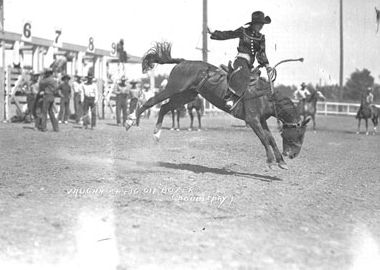
There is a photograph most people in this sport have scrolled past: a cowgirl upside down over a bronc’s head, hat gone, both hands empty. Walter Bowman shot it at Pendleton in 1915. It is one of the most reproduced rodeo photographs ever made, and the woman in it is Bonnie McCarroll.
She was born on her grandparents’ cattle ranch near Boise, Idaho, and was riding buckers at 10. She won back-to-back Pendleton saddle bronc titles in 1921 and 1922. In that same 1922 season she took the bronc riding championship at Madison Square Garden, for a $400 purse, and at Cheyenne Frontier Days, which the National Rodeo Hall of Fame says no cowgirl had done before. She won a bronc riding at Yankee Stadium in 1923, and at Tex Austin’s international rodeo at Wembley Stadium in 1924 she took the Lord Selfridge Trophy as champion lady saddle-bronc rider.
Her ladies’ bronc saddle, built by O.J. Snyder Saddlery around 1925, is in the American Rodeo Gallery in Oklahoma City.
McCarroll was killed on a bronc at Pendleton in 1929. Women did not compete there again for more than seven decades, and when they came back in 2000 it was barrel racing, on the Green Mile.
3. Vaughn Krieg
Vaughn Krieg grew up on a Colorado ranch, was riding before she turned 5 and helped break horses as a girl. By 18 she was married with two sons, living near Mesa de Maya.
Her sister Gene was a trick rider with a contract to fill in 1926 when her appendix ruptured. Krieg went in her place. She was 22, and she stayed in the business.
She rode broncs, trick rode and bulldogged, including off the running board of a moving automobile. In 1934 she won the bronc riding at Madison Square Garden for $615.
After marrying Lynn Huskey in 1933 she bought a ranch near Towson, Oklahoma, and named it the Flying V. She had been producing rodeos under that name since 1937, and in 1942 she incorporated the Flying V All Cow-Girl Rodeo Company and opened it at the Lamar County fairgrounds near Paris, Texas. That was six years before the meeting in San Angelo. No published record shows she joined the GRA once it existed. The National Cowgirl Museum and Hall of Fame inducted her in 1989.
After San Angelo
4. Margaret Owens Montgomery
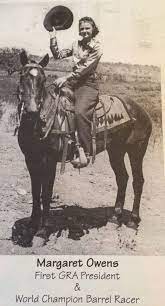
Margaret Owens Montgomery was elected the first president of the Girls Rodeo Association when 38 women founded it at the St. Angelus Hotel in San Angelo, Texas, on Feb. 28, 1948. She is the first name on the WPRA roll of presidents, and the Texas State Historical Association records her the same way.
She won three world titles in the association’s first season, in barrel racing, the all-around and cutting horse. The WPRA describes that as the first time a GRA member won three world championships in a single year. She is also the first name on the WPRA’s roll of world champion barrel racers, and its records credit her with a second world barrel racing title in 1951 aboard a horse named Joe Brown.
The Texas Rodeo Hall of Fame, which inducted her in 2014, says she was a fixture at Pecos and won the girls’ calf roping there four years running. The same account credits her with beating the men in the calf roping at Pecos on Joe Brown.
Amy McGilvray won two world championships in 1949, the barrel racing and the all-around, and she was 14 years old.
She was a rancher’s daughter out of Mertzon, Texas, about 40 miles from Ozona. She rode a bay gelding called Pee Wee, and she trained and groomed her own horses. In the same season she was winning world titles she was serving as secretary of her high school class.
Then the record stops. There is no obituary, no married name, no county record, nothing in a Texas newspaper archive after 1950. The WPRA’s champion roll carries her name for 1949 and the trail ends there.
6. Jackie Worthington
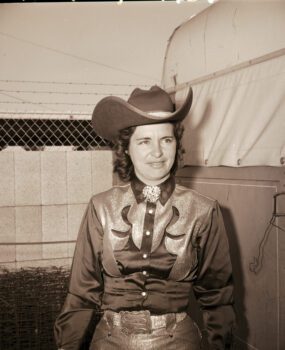
Jackie Worthington
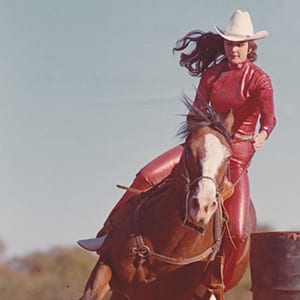
Jane Mayo Bondurant
Jackie Worthington learned on whatever was standing in the pen. The National Cowgirl Museum and Hall of Fame describes her practicing on everything on the place, from the milk-pen cows to the broodmares. Her first exhibition bull ride, in 1940, paid $7.50.
She was 23 when she helped found the Girls Rodeo Association and took the job of bareback riding director. In that first season she won the world in bareback riding and in bull riding. The WPRA’s champion roll then has her winning the world in cutting horse in 1952, 1953, 1956, 1957, 1958 and 1966. Twenty-three world championships in a 13-year career.
She was the association’s president from 1954 to 1956. On Jan. 30, 1955, she and RCA president Bill Linderman signed an agreement under which the RCA would urge its committees to hold a GRA-approved barrel race and would contract with no barrel racing association other than the GRA. That page is why there is a barrel race at a PRCA rodeo.
She quit at 32 and went home to the West Fork ranch outside Jacksboro. The Cowgirl Museum honored her in 1975.
7. Jane Mayo
Jane Mayo was born on New Year’s Day 1937 to a ranching family near Okemah, Oklahoma, and started competing at 12. At junior rodeos she entered barrel racing, calf roping, team roping, bronc riding and bulldogging. She graduated from Okemah High School in 1955 and joined the GRA the same year.
She was fourth in the world at 21. Then she won the world barrel racing championship three years running on a horse called V’s Sandy, by Oklahoma Star, Jr., a son of the AQHA foundation sire Oklahoma Star. The money went up every year: $5,814 in 1959, $7,833 in 1960, $8,356 in 1961. She won those three titles in three different towns, because the finals kept moving. Clayton, New Mexico. Scottsdale, Arizona. Santa Maria, California.
In 1961, at 24, she and Bob Gray published Championship Barrel Racing. It was the first instructional book the sport had, and it went to at least a second printing in 1967. Okemah declared a Jane Mayo Day on April 23, 1961.
She is 89, lives in Durant, Oklahoma, and has been donating her material to the National Cowboy & Western Heritage Museum, which put her in the National Rodeo Hall of Fame in 2024.
8. Mildred Farris
Mildred Farris | National Cowboy Museum photo
courtesy WPRA
Mildred Cotten graduated from Sul Ross with a degree in physical education in 1955, married John Farris in May of that year after meeting him at the Texas Cowboy Reunion Rodeo in Stamford, Texas, and won her first Texas Barrel Racing Association title the same year.
She won the first GRA rodeo she ever entered, San Antonio in 1958, and finished that season 10th in the world. Then she qualified for the first 12 National Finals Rodeo barrel races ever contested, 1959 through 1970, consecutively, winning Denver, San Francisco, Pecos and the Snake River Stampede along the way. The WPRA’s table of fastest times at the NFR begins with Mildred Farris and goes no further back: 16.60 in 1968. Put that next to what it takes now.
She never won a world title. She was second in 1959 behind Jane Mayo by $550, second in 1960 behind Mayo again by $799, and second in 1969 behind Missy Long by $1,246. Three reserve world championships, all three inside about a thousand dollars.
What she did instead was run the sport. She was president of the association from 1965 to 1971 and PRCA Secretary of the Year nine times. John staked the barrel pattern and ran the timed-event chutes at every NFR from 1967 on. She carried the American flag into the NFR opening ceremonies for 17 years.
Ann Lewis and her twin sister, Jan, were given a half-wild bay gelding when they were 7. His name was Charlie Bay Dan. Everybody called him Dan.
Lewis had already won money by then. Her first open event paid her at Atoka, Oklahoma, when she was 5. She was an IPRA member at 8. She turned pro in March 1968, at 10, and the National Cowgirl Museum and Hall of Fame says she consistently outran more experienced racers.
She won $8,928 that season to Kay Whitaker’s $8,271, and she was the 1968 Rookie of the Year.
The family ran a performance at Little Rock and pointed the rig at Waco, where they had slack in the morning. Sissy Thurman rode with them. Thurman was 34, the GRA’s barrel racing director and second in the world standings behind Lewis.
At 1:15 a.m. on Oct. 2, on a highway west of Hope, Arkansas, a semi struck two cows, jackknifed and turned over. The Lewis rig ran into the wreckage. Ann Lewis died. Jan died. Their mother, Rose, died. Thurman died. Two barrel horses died.
The WPRA keeps the accounting in a footnote under its 1968 standings: Prather and McFarlane replaced Lewis and Thurman at the National Finals. Lewis’s lead held to the end of the season and the Girls Rodeo Association gave her the world championship.
She is still in the WPRA record book twice, as youngest world champion and youngest NFR qualifier, both at 10 years old. The next names on that list are LaTonne Sewalt at 11 in 1950, Jackie Jo Perrin at 13 in 1977 and Charmayne James at 14 in 1984.
Verna Booker Hightower appears in an article after competing at now RodeoHouston
Verna Lee Booker Hightower got the name Boots as a little girl on her family’s fruit-tree farm in Spring, Texas, for how much she loved horses and being outdoors. It stuck for life.
She worked as a medical assistant at the Lyons Medical Clinic in Houston’s Fifth Ward and was, per the Handbook of Texas, an accomplished pianist. She and her husband, Ted, raised six children and put all of them in the family rodeo business. They moved house to be near the Diamond L, J.L. Sweeney’s arena on South Main.
She carried cards in the National Colored Rodeo Association and the Girls Rodeo Association, and the Texas State Historical Association credits her as the GRA’s first African American member. In 1969 she became the first African American woman to take part in barrel racing at the Houston Livestock Show and Rodeo, and the Hightowers were the first African American family listed among the show’s trainers and owners.
Six years before Houston she and Ted had sued the Houston school district and won, which is how their six children got into a school near their own house. She died in Harris County on Aug. 27, 1970, at 40. The National Multicultural Western Heritage Museum honored her in 2007, and the Houston rodeo’s Black Heritage Committee gave her a humanitarian award.