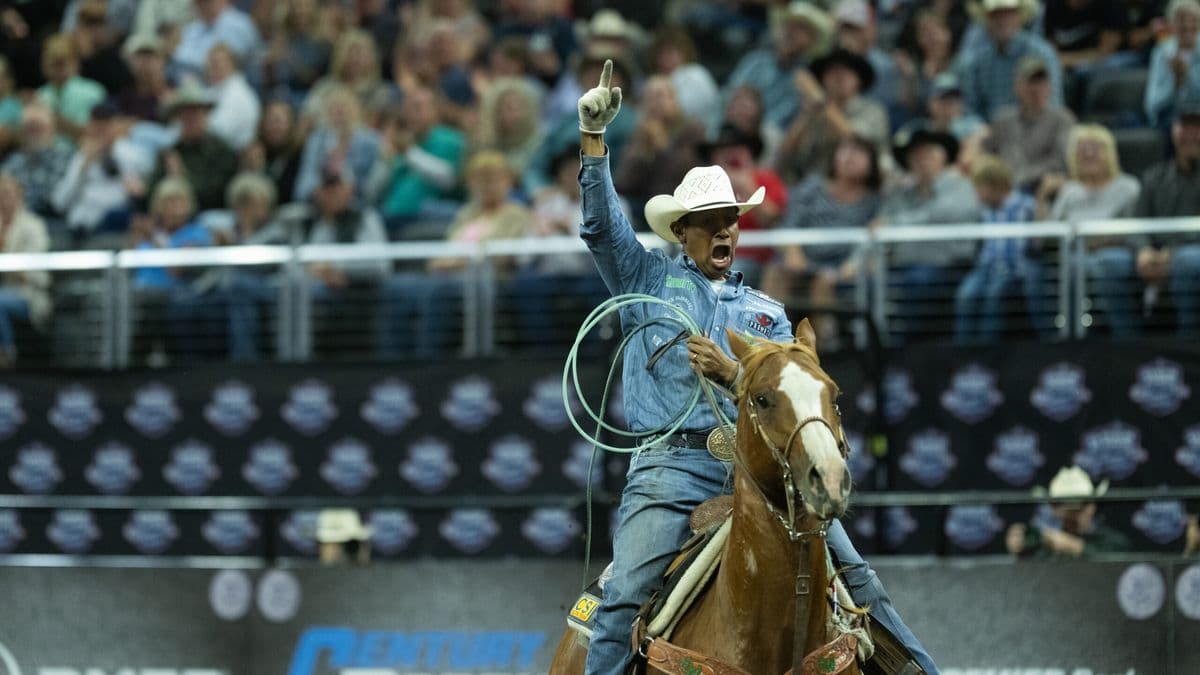
Korbin Rice and Cooper Freeman needed only a time—not another 4-flat run—to win $50,000 apiece in the Calgary Stampede Rocky Mountain Cup final July 8.
By the time they backed into the box as the last team in Calgary’s final four, the short round had fallen apart in front of them. They did not need to be heroes. They just needed to catch.
Rice was a little off the start, ran all the way to the steer and turned him. Freeman took two extra swings and cleaned him up. Seven flat was not how either pictured winning the richest team roping of the summer, but it was exactly what the situation required.
“It’s not the way that a short round is supposed to go by no means,” Rice said. “It maybe even made it a little more nerve-wracking, just having to put a time on the board, than if we had to be 4.5 or something.”
Before Rice backed in, he decided he would stay aggressive if the start and throw were there and make sure they caught if they were not. Freeman made the same calculation from the heel side. A clean run would win it.
The 7.0 did more than pay $50,000 apiece. It made their first trips to the National Finals Rodeo feel real.
“The first thing that came to mind was, ‘Man, that probably sealed the deal on making the Finals,’” Freeman said.
That ability—to go fast when needed and catch when it matters—is one of the biggest reasons Rice, 24, and Freeman, 23, have spent 2026 out front.
As of July 23, they led their respective PRCA world standings with $170,455.32 apiece. RodeoHouston put them there in March, Calgary gave them separation in July and wins at the Snake River Stampede and California Rodeo Salinas proved the season was bigger than two checks.
They took the lead early. Then they gave everybody else months to try to catch them.
The Ones to Catch
For most of their young ProRodeo careers, Rice and Freeman had been the ones chasing.
Rice’s first years were spent learning how to enter, travel and make an 80-rodeo season work. His rookie year, he and Caleb Hendricks drove the summer with one horse apiece. Freeman bought his card at 19, circuit rodeoed in the Great Lakes and spent his rookie season with Mason Appleton.
“There’s stuff that you can’t even tell people that you’ve just got to figure out along the way,” Freeman said. “I feel like the more I’m going, the more I’m figuring out, but then I talk to older guys and it’s crazy how much I don’t know.”
They had already roped together at the College National Finals Rodeo when Freeman asked Rice for a run at the San Antonio qualifier in Uvalde, Texas. Rice was full there but needed a partner for the rest of the year. The deal survived a less-than-perfect 2025 and rolled into 2026 intact.
“They didn’t have the best year last year, and they just kept roping,” two-time World Champion Chad Masters said. “They didn’t change anything. They just kept staying hooked, and next thing you know, everything’s coming together.”
They also genuinely like each other.
“I really like our team,” Freeman said. “Korbin scores great. He’s got a couple great horses, and he hardly ever takes us out of the game. He turns a lot of steers and gives me a lot of opportunity. We get along great, and we have fun together.”
They do not spend much time dissecting every run. They identify what went right, correct what did not and move on.
“I don’t like trying to set a trap,” Freeman said. “That’s one of my favorite things about our partnership—we both have confidence in each other.”
Cooper heeling at the Rocky Mountain Cup. | Calgary photo by Emily Gethke
Korbin heading one in Calgary. | Calgary photo by Emily Gethke
Both Roads Lead to the Top
Rice grew up in Hobbs, New Mexico, roping calves with his brother, Jabin, before team roping took over in high school. He attended Cisco College, transferred to Tarleton State University and put himself in the middle of the Stephenville, Texas, roping scene.
“It’s hard to go over there and rope with people that rope better than you and get worse,” Rice said. “You’re learning stuff all the time.”
Freeman grew up in Carthage, Missouri, around his family’s indoor arena, steakhouse and Western store. Ropings and barrel races ran through the arena every week, but making a living with a rope still did not seem obvious.
“It was always something I dreamed of whenever I was a little kid,” Freeman said. “Growing up in Missouri, nobody had moved off and truly made a living. It was always kind of mentioned that it’s hard to do—you’re not going to rope for a living.”
That changed when he went to Cisco and moved in with Tyler and Brittany Worley. Texas put him around the people, horses and work required to make professional rodeo a real option.
By college, both had reached the same realization: They might be good enough to try. Rice had won the 2024 Ariat WSTR Riata Open Finale with Jake Edwards, while Freeman’s first major ProRodeo win came at Cody, Wyoming, with Chris Thompson.
Rice and Freeman were not automatically in the 2026 RodeoHouston field. They had to earn their way through the early 2026 standings by Dec. 1, which meant entering hard as soon as the season began. Rice drove to Brawley, California, while Freeman flew, all to win just enough to stay inside the qualifying line.
Their first trip to NRG Stadium began with an illegal head catch. They recovered to win Round 2, advance from their super series and survive both the semifinal and 10-man finals.
“Looking back now, it’s kind of crazy what all took place,” Freeman said. “Somebody making a good run could have changed the whole week for us. It’s pretty crazy to see how God’s got His hand on it. He had a plan for us.”
Before the four-man Championship Shootout, reigning RodeoHouston champion Derrick Begay gave Rice advice that changed the moment.
“This is the fun part,” Begay told him.
“The stress is over,” Rice said. “We’re guaranteed $10,000; catch, miss or fall off, it doesn’t matter. It’s been a great week. Let’s just go make a good run and finish it out.”
First out, Rice and Freeman were 4.6 seconds. They did not think it would hold.
It did.
The championship paid $65,000 apiece, bringing their Houston totals to $70,750 each and pushing them to No. 1 in the world with $85,400.74 won at the time.
“I’m not sure that it’s sunk in yet, but it’s great,” Freeman said then. “It was the coolest rodeo I’ve ever been to, and to win it was pretty dang cool for my first time there.”
By summer, Houston had changed the way each steer felt.
“Everything just feels comfortable every time we get back in the box now,” Rice said in June. “You can go out there and do whatever the steer lets you do on him and try to do as good as you can every time.”
Freeman felt it, too. One empty week became just an empty week, not the beginning of a collapse.
“It wasn’t like, ‘Holy cow, we didn’t win anything this week,’” Freeman said after Calgary. “It was just, ‘We’re going to win something next week.’”
Korbin Rice and Cooper Freeman at RodeoHouston. | Mallory Beinborn Photo
Horsepower Behind the Lead
Rice and Freeman’s season has depended on two horses that fit their styles.
Rice’s sorrel, Papa Rock, registered LJ Jumpin Jack Flash, came from Masters, who let Rice ride him through college, jackpots and his rookie season before offering to sell him.
“The reason the horse is what he is is because of Korbin,” Masters said. “When you watch Korbin ride the horse, he rides him 10 times better than I ever did. That horse to him is the game changer.”
Freeman found Carbon, his 10-year-old dun registered PBD Corndog, when his other rodeo horses were hurt last summer. He called Trey Smith, ran five or six practice steers on Carbon and bought him.
“He’s been very good to me ever since,” Freeman said. “He’s very forgiving and always on my team.”
Together, Papa Rock and Carbon have allowed Rice and Freeman to adjust to whatever a run requires. They were 4.0 in Calgary’s semifinal, then 7.0 in the final when catching meant $50,000 apiece.
What the Greats See
Rice and Freeman say they are winning because they are catching, their horses are working and their confidence is high. The world champions watching them see more.
“Korbin can hit 10 of them in the back of the head, and you can’t tell if he’s been winning or hitting them in the back of the head,” Masters said. “Missing doesn’t back him off. He stays aggressive.”
Masters believes Rice’s aggressiveness can work in the Thomas & Mack, especially paired with Freeman’s steadier style.
“As laid-back as Cooper is and as aggressive as Korbin is, I think if there are ever any young rookies that can handle it, it will be them,” Masters said.
Eight-time World Champion Clay O’Brien Cooper sees their ability to execute when the opportunity is there.
“They’ve just kept their heads down and kept doing their deal,” Cooper said. “The bright lights haven’t got too bright for them.”
“They can be fast or they can go catch, and that’s the name of the game,” he said. “Sometimes you back in there and all you’ve got to do is get a time. Sometimes you’ve got to be the fastest team of the night. They can really do both.”
Seven-time World Champion Jake Barnes noted that teams in his era often went to 100 rodeos trying to build the kind of lead two major wins can create today. The money has changed, but Rice and Freeman were positioned to capitalize.
“You can say it’s luck, but they did it, so you can’t take anything away from them,” Barnes said.
Barnes also offered the caution that will follow them until December: A July world lead is an opportunity, not a championship, and first-time qualifiers face a 10-night pressure test they have never experienced.
Rice and Freeman understand that. They mapped out all 80 rodeos before Calgary. After Calgary, they went to Salinas and won another $7,448 apiece.
“We’re going to stay out here and stay after it and try to stay No. 1,” Freeman said. “Maybe break some records or something fun like that.”
Still Out Front
Calgary was Freeman’s first moment of certainty that the NFR dream had become real.
“That’s one of the steers you only get to catch once in your life—the steer that you catch to make your first NFR,” he said.
Rice felt the same excitement, but neither wanted December to take over July.
“I’m pumped,” Rice said. “I’m super excited. But it’s still just one steer at a time. Not that it’s not in the back of our heads the whole time we’re out here, probably until December, but we can’t let it get to be too big a part of the rest of our summer.”
Back in March, before their biggest run at Houston, Begay told Rice the pressure was over.
This was the fun part.
Four months later, still No. 1 and still entered, Rice and Freeman were finding out just how long the fun part could last.